AI Isn’t Just Writing Code, It’s Evolving It
6 Surprising Truths About the Next Software Revolution

Brief
Thesis: We’re not approaching a future where AI helps us write software, we’re entering one where software writes, tests, and selects itself. AlphaEvolve is the proof-of-concept; world models and LLM-as-judge architectures are the infrastructure. The timeline is 18-24 months for infrastructure, 4-5 years for production UX in enterprises.
Angle: Most coverage treats AlphaEvolve as an optimization tool for narrow domains. That’s like describing the iPhone as “a better iPod.” The real story is the paradigm shift from specification to search, what I call “The Great Inversion.” The skeptics who say evolutionary AI can’t handle “subjective” domains like UX underestimate Quality-Diversity algorithms and the power of anti-goals to constrain infinite search spaces.
Framework: The Great Inversion (specification → search) + Complex Adaptive Systems (the right software emerges from designed conditions) + The Bitter Lesson (general methods + compute beat hand-crafted approaches)
Historical anchor: John Holland’s genetic algorithms (1975) → John Koza’s genetic programming (1992) → MAP-Elites (2015) → ELM (2022) → FunSearch (2023) → AlphaEvolve (2025)
Recent anchor: AlphaEvolve (2025), Genie 3 world models (2025), DeepSeek R1-Zero pure RL, SIMA 2 self-directed learning
The 6 Truths: 1. The “new” idea is 50 years old, but it just got rocket fuel (Holland → Koza → AlphaEvolve) 2. We’re moving from specification to search (The Great Inversion) 3. It’s not an AI, it’s a feedback loop that never sleeps (Generate → Filter → Evolve) 4. The recursive loop is where it gets weird (AI optimizing the systems that train it) 5. The new bottleneck is judgment, not creation (evals encode values) 6. The “UX can’t be evolved” objection is about to look dated (A/B testing at 10,000x speed)
Key tension: This will happen. The question is whether you’re positioned to shape what emerges, or wake up to find the ecosystem evolved without you.
1.0 Introduction: The Dawn of Self-Evolving Software
“The future is already here-it’s just not very evenly distributed.” - William Gibson

When the tractor arrived on American farms, the transformation seemed obvious: faster plowing, more acres per day. What took 90 minutes per acre with a team of horses dropped to 30 minutes with an early tractor and eventually to 5 minutes with modern equipment. But the transition was slow. Mass production began in 1917; tractors didn’t outnumber horses on American farms until 1954. Nearly four decades to replace the horse.
The deeper revolution took even longer to see and feel.
Horses and mules consumed over 20% of the food they helped produce, 93 million acres of American cropland existed just to feed draft animals. The tractor didn’t just do the same work faster. It eliminated a fundamental constraint that had shaped agriculture for millennia. Suddenly, that land could grow food for humans, not horses. Farm sizes tripled. The cash-crop economy emerged. Agriculture became an industry.
We’re in that moment with AI right now. The world remains mesmerized by AI agents that slot into the existing software development lifecycle; AI that designs, codes, tests, and builds as if it were a human, just faster and cheaper. This is the tractor replacing the horse: same rows, same crops, same process, mechanized. Useful, yes. But it misses the deeper revolution entirely.
The real revolution is unfolding in systems that don’t need the lifecycle at all.
Six Truths About Evolutionary AI
Truth 1: The “New” Idea is 50 Years Old
In May 2025, Google DeepMind unveiled AlphaEvolve, an evolutionary coding agent designed for general purpose algorithm discovery and optimization. Unlike domain specific predecessors like AlphaFold (protein structure) or AlphaTensor (matrix multiplication), AlphaEvolve can operate across scientific and engineering domains. It’s not a specialist. It’s infrastructure for evolutionary search.
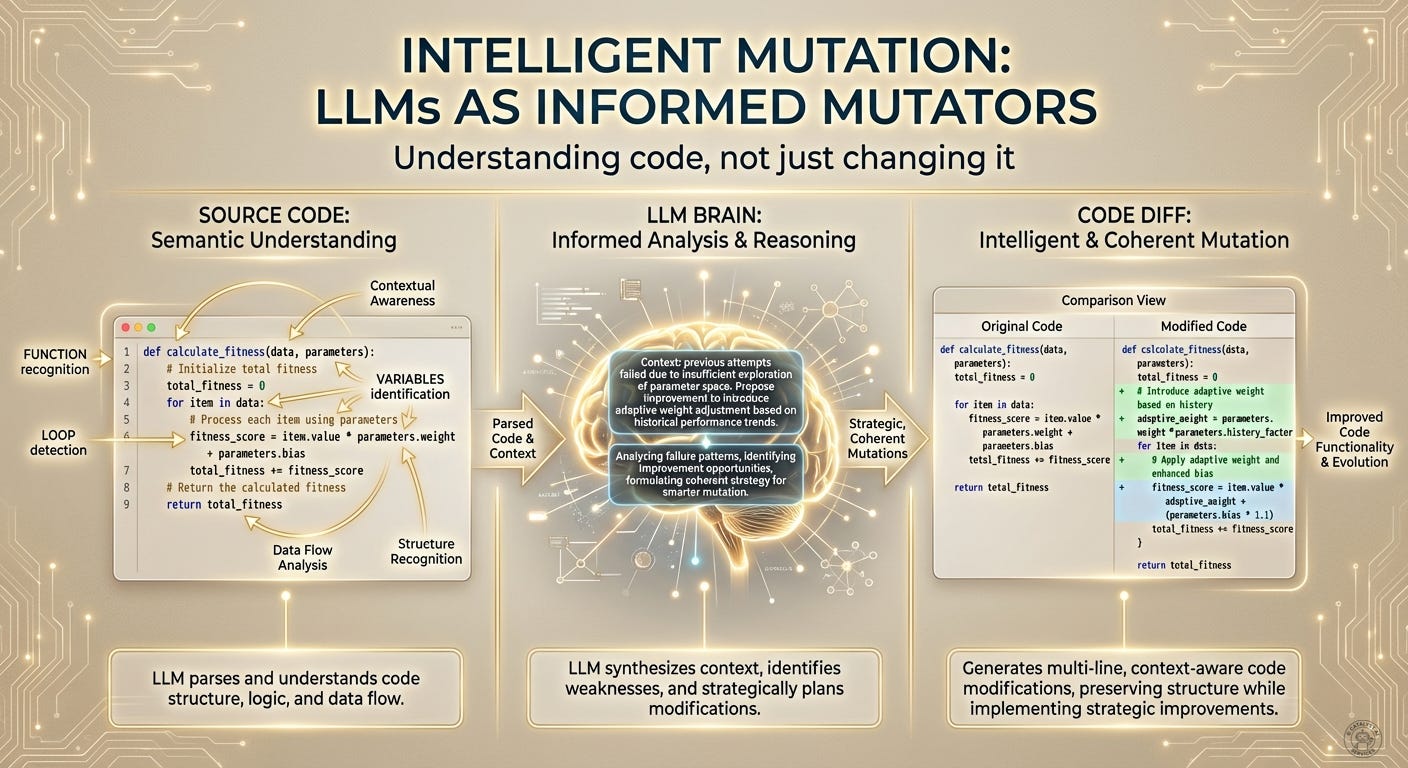
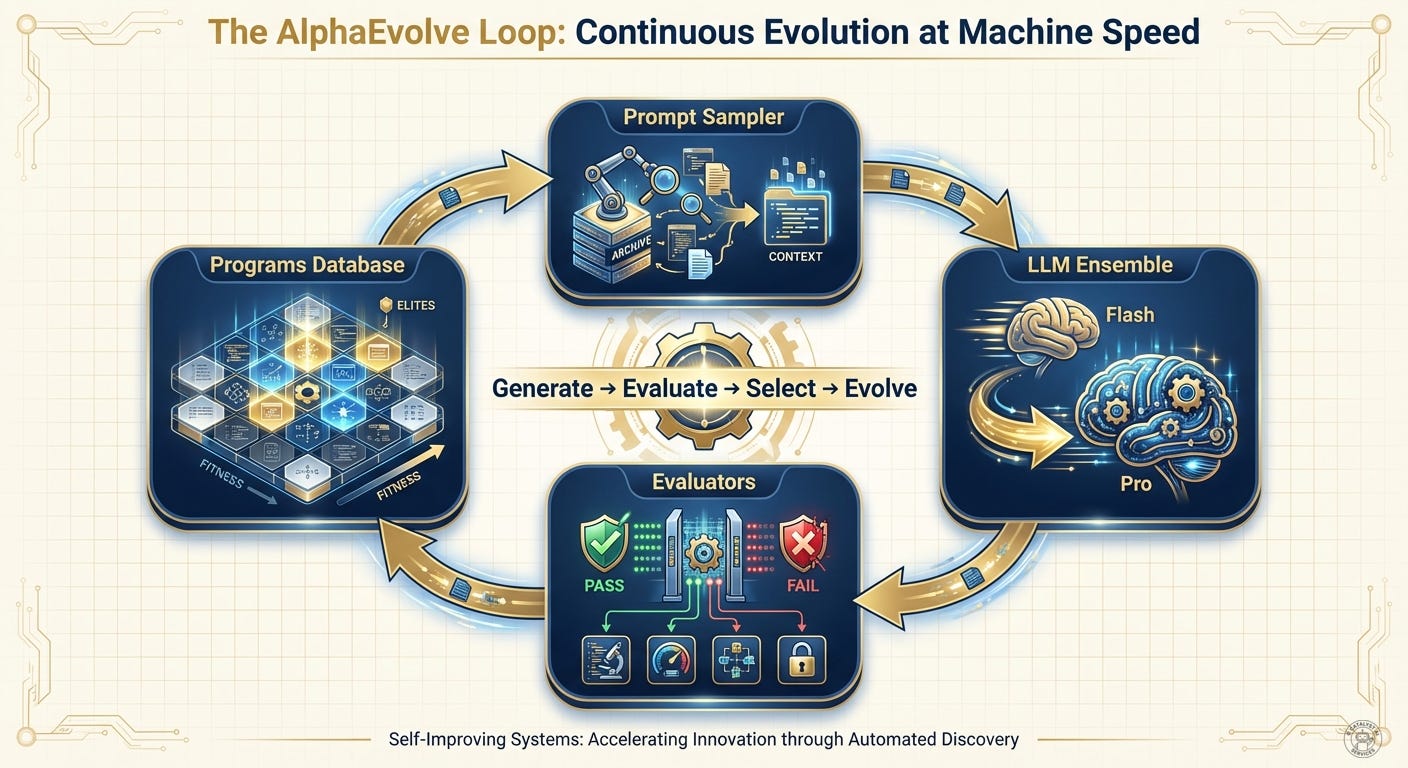
The architecture pairs the creative problem-solving of Gemini models with automated evaluators that verify answers, wrapped in an evolutionary framework that improves upon the most promising ideas. An ensemble of Gemini Flash (fast, exploratory) and Gemini Pro (slow, deep reasoning) proposes code variations. Evaluators score them against defined objectives. The best solutions breed the next generation. Repeat. It’s evolution, but instead of random mutations, an intelligent system proposes contextually-aware improvements. Evolution with a genius geneticist guiding every generation.
And it’s already in production. AlphaEvolve optimizes data center scheduling at Google, recovering 0.7% of previously stranded compute (a solution running for over a year). It improved chip designs for Tensor Processing Units. It found a new algorithm for multiplying complex matrices that improves on Strassen’s 1969 result. Most striking: it sped up Gemini’s own training by 23% on a critical kernel. The AI is optimizing the systems that train it.
This didn’t come from nowhere. How did we get here?
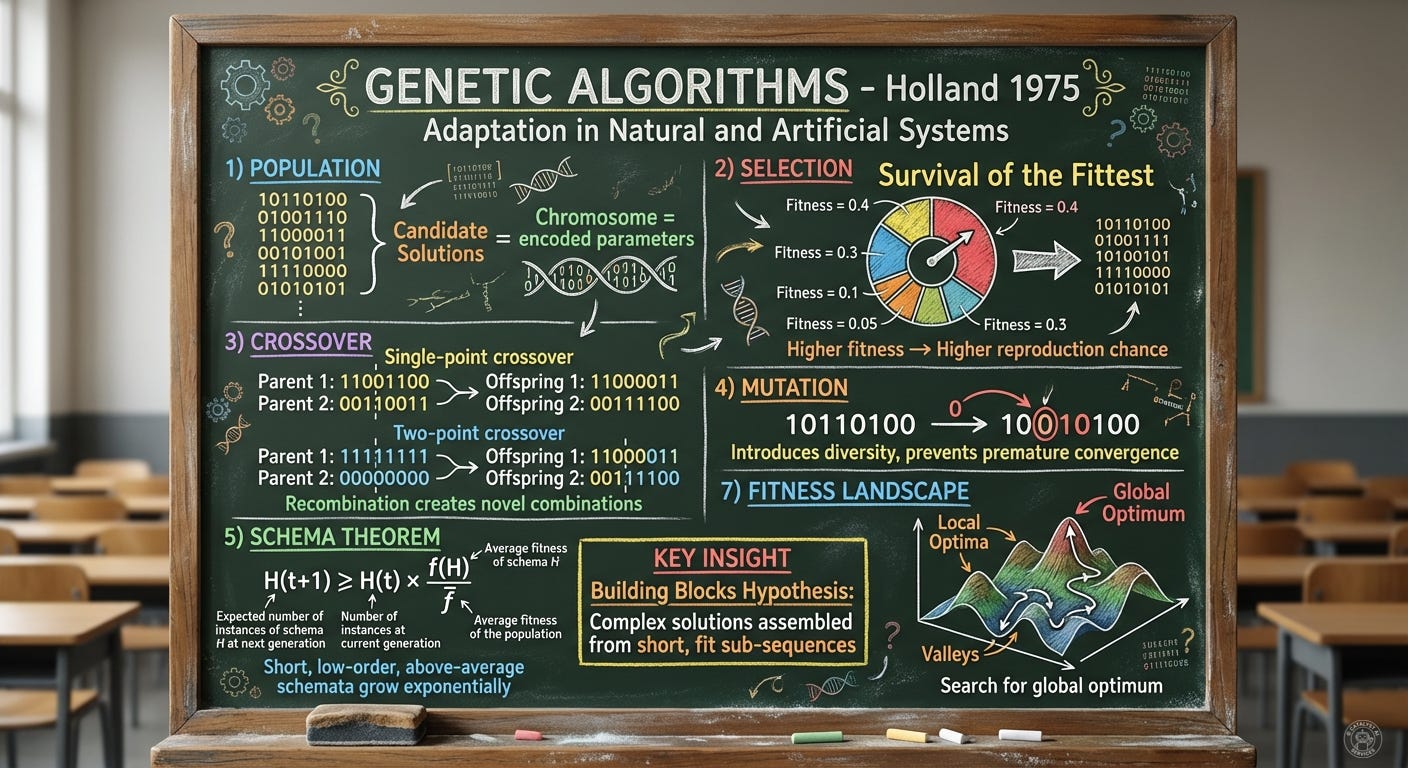
1975: John Holland publishes Adaptation in Natural and Artificial Systems, inventing genetic algorithms. The core insight: mimic natural selection. Start with a population of solutions, test their “fitness” against a goal, breed the winners, mutate the offspring, repeat. Evolution as computation.
Holland was ahead of his time in a specific way. His ideas worked; they just needed more compute than existed. Running genetic algorithms on 1970s hardware was like trying to evolve complex organisms in a puddle: the population sizes were too small, the generations too few, the fitness evaluations too expensive. The theory was sound. The infrastructure wasn’t ready. This pattern would repeat for fifty years.
1992: John Koza publishes Genetic Programming, extending Holland’s approach to evolving actual programs, not just parameters. This was audacious: instead of evolving numbers within a fixed structure, Koza’s system evolved the structure itself,-program trees that could grow, branch, and recombine.
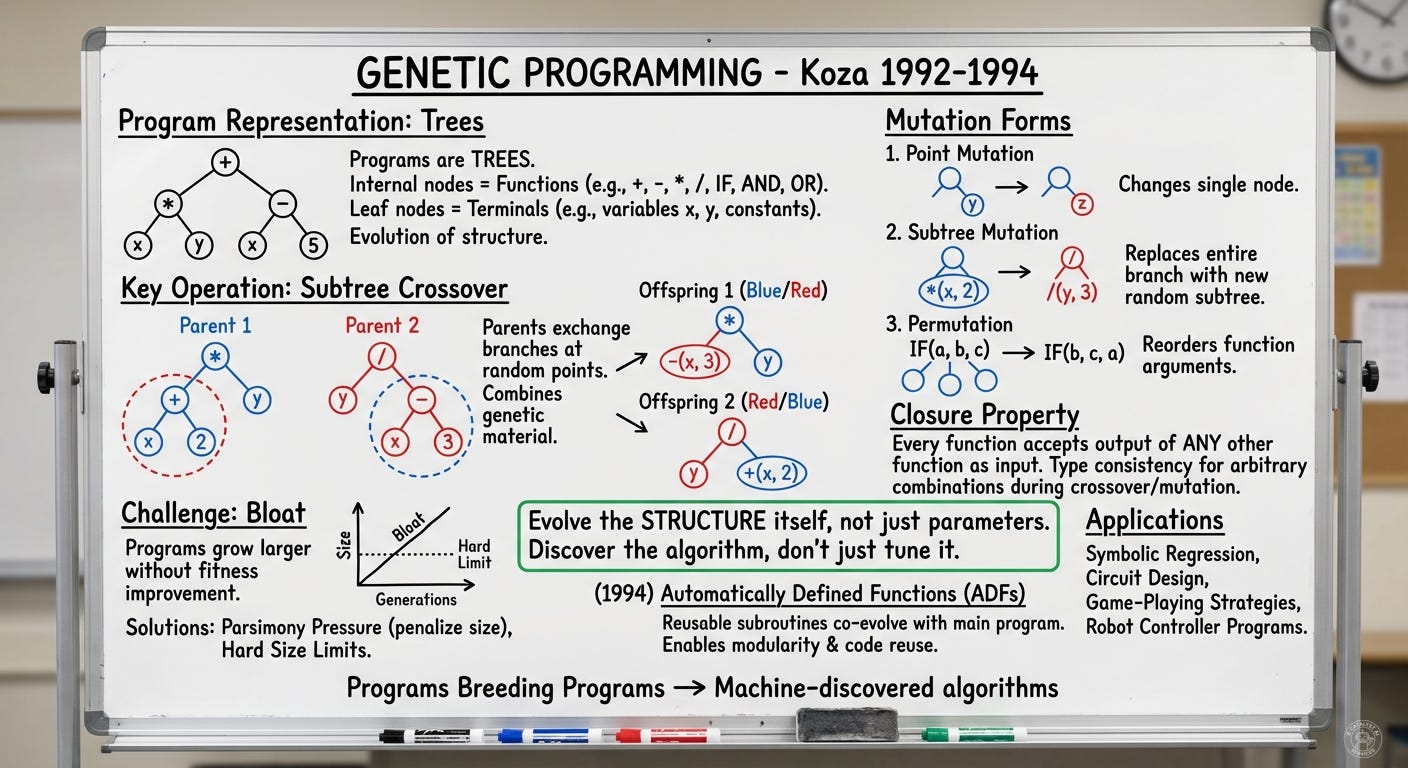
Koza’s systems produced genuine novelty: antenna designs, circuit layouts, software that no human explicitly programmed. But the mutations were random. Most offspring were garbage. The systems spent enormous compute generating and discarding junk, occasionally stumbling onto improvements. For decades, this was enough to be useful in narrow domains, but too inefficient to scale broadly. The missing piece was intelligent mutation.
This is the pattern Rich Sutton identified in The Bitter Lesson: general methods that leverage computation eventually beat hand crafted approaches. Holland and Koza had the general method. They just needed more compute and smarter search.
2015: MAP-Elites introduces quality-diversity: the insight that finding many different good solutions beats finding the single “best” one. Instead of converging on a single optimum, MAP-Elites maintains an archive of diverse high-performers across different feature dimensions. This turns out to be crucial: when you later combine evolutionary search with LLMs, diversity in the population gives the model more creative raw material to work with. AlphaEvolve adopts this directly: its “island” architecture maintains diverse solution populations, preventing premature convergence.
2022: Evolution through Large Models (ELM) by Lehman et al. proposes the key conceptual breakthrough: what if the LLM itself was the mutation operator? Instead of random code perturbations, use a language model to propose intelligent, contextually-aware variations. The paper demonstrates that LLM-generated mutations dramatically outperform random mutations. The model understands what it’s modifying. AlphaEvolve’s Gemini-powered mutation engine is ELM’s concept industrialized.
2023: FunSearch from DeepMind proves the architecture can make genuine discoveries. An LLM generates candidate solutions; an automated evaluator scores them; the best are fed back as examples for the next generation. FunSearch discovered new solutions to the cap set problem in combinatorics, mathematical results that humans hadn’t found. AlphaEvolve is FunSearch’s direct successor: same core loop, but with more sophisticated LLM ensembles, multi-objective evaluation, and Google-scale infrastructure.
Fifty years of ideas. Fifty years of waiting for the infrastructure to catch up. Holland’s theory, Koza’s ambition, MAP-Elites’ diversity, ELM’s intelligence, FunSearch’s proof of novelty, all converging in a single system that can already optimize its own training infrastructure.

Truth 2: We’re Moving from Specification to Search (And This Changes Everything)
I still remember the textbook. Software Engineering: A Practitioner’s Approach by Roger Pressman, a thousand pages of text explaining how to write requirements documents, UML diagrams, and how to use waterfall phases. All with the implicit promise that if you just specified things carefully enough, the software would emerge correctly. CS314 at my university taught the catechism: gather requirements, write specifications, design architecture, implement code. The specification was sacred. The code was its manifestation.
For 70 years, this has been the operating assumption. Software development as a specification problem. Humans define requirements, design architectures, write code. Each artifact is a deliberate choice made by a human mind.
Yes, we’ve moved beyond waterfall. Since the 1990s, Agile methodologies have made iteration and incremental change the norm. We ship faster. We adapt to feedback. We’ve learned that “measure twice, cut once” doesn’t work when requirements shift under your feet.
But Agile is still human driven. Still specification based, just chunked up specifications spread across sprints. Still a single threaded search through solution space, one decision at a time, like a torpedo navigating toward a target. You iterate toward an optimum, never knowing whether it’s a local peak or the global maximum. The search is smarter than waterfall, but it’s still fundamentally serial, fundamentally human, fundamentally constrained by how fast a team can think and build.
The shift we need to make is this: stop engineering software. Start engineering systems whose output is software.
When an AI can generate a thousand variations of an application at near-zero marginal cost, the challenge transforms. You’re no longer building the product. You’re designing the conditions under which good products emerge: the evals that define fitness, the constraints that bound the search, the selection pressures that shape what survives. You’re engineering an evolutionary system, and the software is its emergent property.
Call it “The Great Inversion”: competitive advantage moves from building faster to searching at scale. We go from small family farms to industrial agriculture at scale.

The new role of the software engineer: Not architect, but curator of selection pressure. You don’t lay every brick. You design the evals, the fitness functions that separate good solutions from bad. You cultivate the population. You prune ruthlessly.
At the individual level, this feels like cultivation: tending a garden of solutions, nurturing the promising ones, composting the failures. At the industry level, it looks more like orchestration: a conductor shaping an ensemble of parallel processes, each exploring different regions of solution space. The human touch becomes strategic rather than tactical.
The objections are predictable. Here they are.
“Near-zero cost? LLM inference isn’t free.” Correct. Today, generating 1,000 variations costs real money. But inference costs have dropped 10-100x in the past two years, and the curve continues. More importantly, the comparison isn’t “evolutionary search vs free”; it’s “evolutionary search vs paying a team of senior engineers to manually iterate.” When a week of compute costs less than a week of salaries, the economics flip. We’re approaching that crossover for an expanding set of problems.
“You haven’t eliminated the specification problem, you’ve just moved it.” This is the smartest objection, and it’s partly right. The fitness function IS a specification. Someone still has to define what “good” means. The specification problem doesn’t disappear; it transforms.
Instead of specifying implementation details, you specify evaluation criteria. Instead of writing requirements documents that describe HOW the system should work, you write evals that test WHETHER it works.
The eval becomes the spec. And evals can be layered: high level evals that check business outcomes, mid level evals that verify behavior, low level evals that validate constraints. A constellation of fitness functions at different scales of granularity, each reinforcing the others.
The crucial difference: specification-as-code requires you to anticipate every edge case upfront; specification-as-eval lets you define outcomes and let the system discover paths you couldn’t have imagined. You’re specifying what, not how. That’s a genuine reduction in cognitive load, even if it’s not elimination.
“Most software doesn’t have clear fitness functions.” Also partly true.
Optimizing a matrix multiplication kernel has objective metrics; “make the onboarding flow feel intuitive” doesn’t. But enterprise software does have more measurable outcomes than this objection assumes: error rates, latency percentiles, completion rates, support ticket volume.
The domains without any measurable proxy are smaller than they appear, and shrinking as LLM-as-judge capabilities improve (more on this in Truth 6).
“You’re conflating optimization with creation.” This is the most sophisticated objection, and it deserves a direct response. Yes, AlphaEvolve optimizes existing structures where the objective function is mathematically precise. Extrapolating to creating new structures where objectives are ambiguous is a logical leap.
But it’s a leap that Quality-Diversity algorithms are designed to make. Traditional optimization converges on a single optimum; QD algorithms maintain diverse high performers across different feature dimensions. The goal isn’t “find the best solution” but “find many good solutions that are different from each other.” This turns the infinite search space of creation into a tractable exploration problem.
Anti-goals constrain the space further: instead of specifying what you want (impossible for open ended problems), you specify what you absolutely don’t want. The forbidden zones shrink the search space to something evolutionary systems can explore efficiently. Creation becomes search through a constrained, diverse landscape.
“Evolved code will be unmaintainable.” This deserves serious consideration, and I address it in the failure modes section. The short answer: yes, evolved code optimizes for fitness, not readability. But “maintainability” assumes humans will maintain it. If the same evolutionary system that generated the code can also fix bugs and add features, the maintenance model changes. We’re not there yet, but the assumption that humans must understand every line is itself a paradigm we may leave behind.
“Regulators won’t accept ‘it evolved.’” True for now, and this will slow adoption in healthcare, finance, and safety critical systems. But regulators adapt. The question becomes: can you demonstrate the testing regime was rigorous, even if the generation process wasn’t hand coded? Evolutionary systems with comprehensive test suites may eventually satisfy regulators better than hand coded systems with spotty coverage. The audit shifts from “show me the code review” to “show me the eval suite.”
Aside: This isn’t just a change in how software gets written, it’s a prediction about industrial structure. Companies organized around artisanal coding will be outcompeted by those organized around evolutionary search, the same way small farms were outcompeted by industrial agriculture. There’s something lost in that transition: craft, intimacy, the satisfaction of hand built solutions. And something gained: scale, consistency, capabilities beyond what any artisan could achieve. I’m not purporting to say which one is better, but certainly there is one that will result in more effective and delightful software at scale.
Truth 3: It’s Not an AI, It’s a Feedback Loop That Never Sleeps
LLMs are often dismissed as “stochastic parrots”, remixing training data, incapable of genuine novelty. But this framing ignores what happens when you combine generalization with evolutionary search.
Consider what LLMs actually are. Their training distribution is essentially all of digitized human knowledge: every paper, every codebase, every forum thread, every documented solution to every documented problem. While this might not be literally true, the difference probably doesn’t matter.
Transformers don’t just memorize, they build internal representations that capture structure. They learn that certain patterns transfer across domains. They develop intuition for what might work, even in contexts they’ve never seen verbatim.
This is the foundation for exaptation, the evolutionary principle where a trait evolved for one purpose gets repurposed for another. Feathers evolved for thermoregulation, then got exapted for flight. Transformers do something analogous: they borrow optimization strategies from one domain and apply them to another, finding solutions in the white spaces between documented knowledge.
Now add evolutionary selection. Random mutation introduces genuine novelty, perturbations the model wouldn’t have proposed on its own. The fitness function filters ruthlessly. Survivors breed. The population drifts toward regions of solution space that no human explicitly mapped. It’s a system with three interlocking components:
Generator (LLM): Proposes variations by drawing on cross-domain knowledge and structural intuition
Evaluator (Automated Testing): Measures fitness against defined criteria, no opinions, just outcomes
Selector (Evolutionary Framework): Keeps winners, kills losers, feeds survivors back to the generator
This Generate → Filter → Evolve loop runs continuously. No coffee breaks. No meetings. No weekends.
Systems like X-evolve push this further by evolving entire solution spaces at once, generating tunable programs with built-in parameters rather than single fixed solutions. This moves from “find the best needle in a haystack” to “find the most promising haystack.”
The result is a serendipity engine, discovering solutions beyond the horizon of human intuition. Not through genius, but through exhaustive exploration of the white spaces, at machine speed.
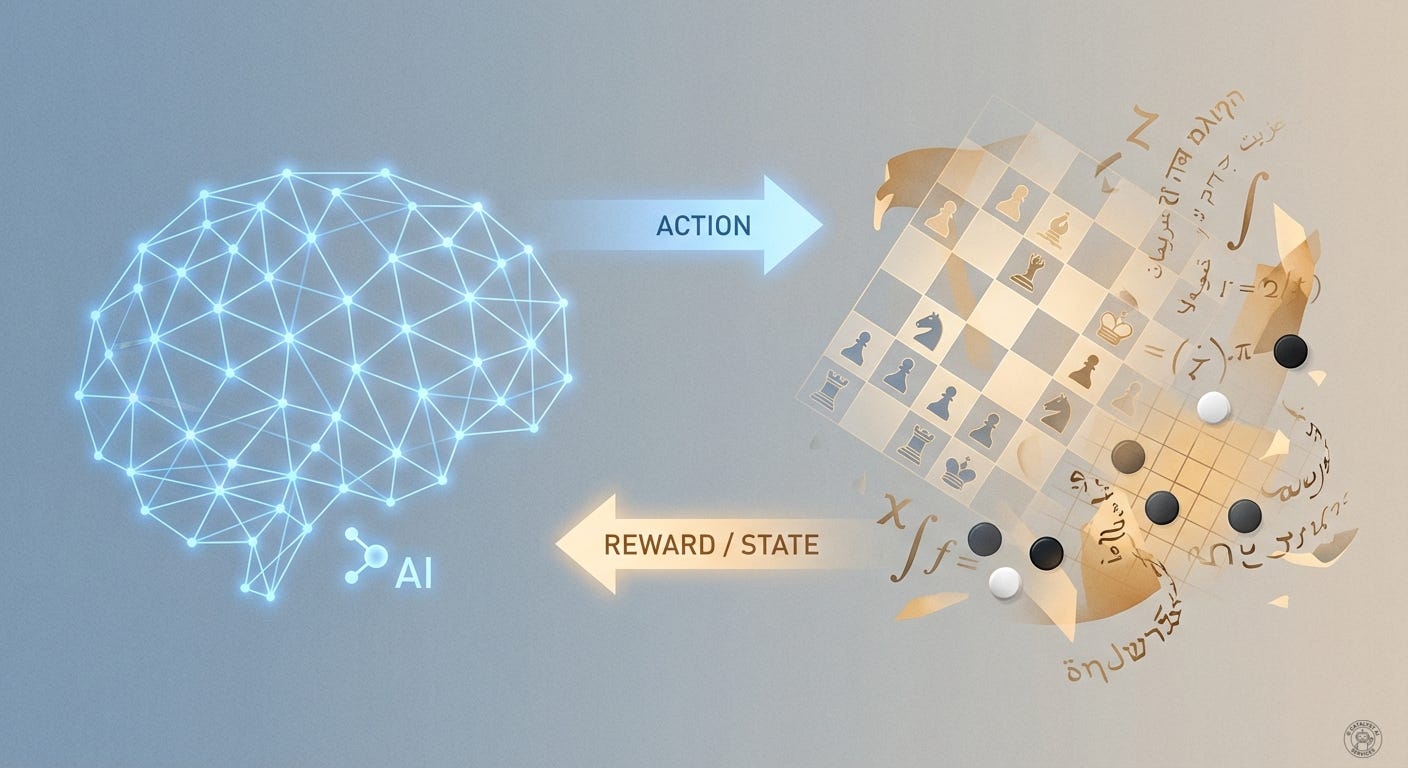
The implications extend beyond code generation. AlphaZero proved that pure reinforcement learning, with no human examples, could master chess, shogi, and Go simultaneously. DeepSeek R1-Zero extended this insight to language: a model trained purely through RL, with no supervised fine-tuning, improved its AIME math competition accuracy from 15.6% to 71.0%. SIMA 2 takes it further: an agent that learns through self-directed play in 3D virtual worlds, creating what DeepMind calls “a virtuous cycle of iterative improvement” where agent experience becomes training data for subsequent versions.
The pattern is consistent: the world itself becomes the eval. The system plays against reality, and reality provides the fitness signal. This is evolutionary learning in its purest form: no human curriculum, no curated examples, just search and selection at scale.
Truth 4: The Recursive Loop is Where It Gets Weird
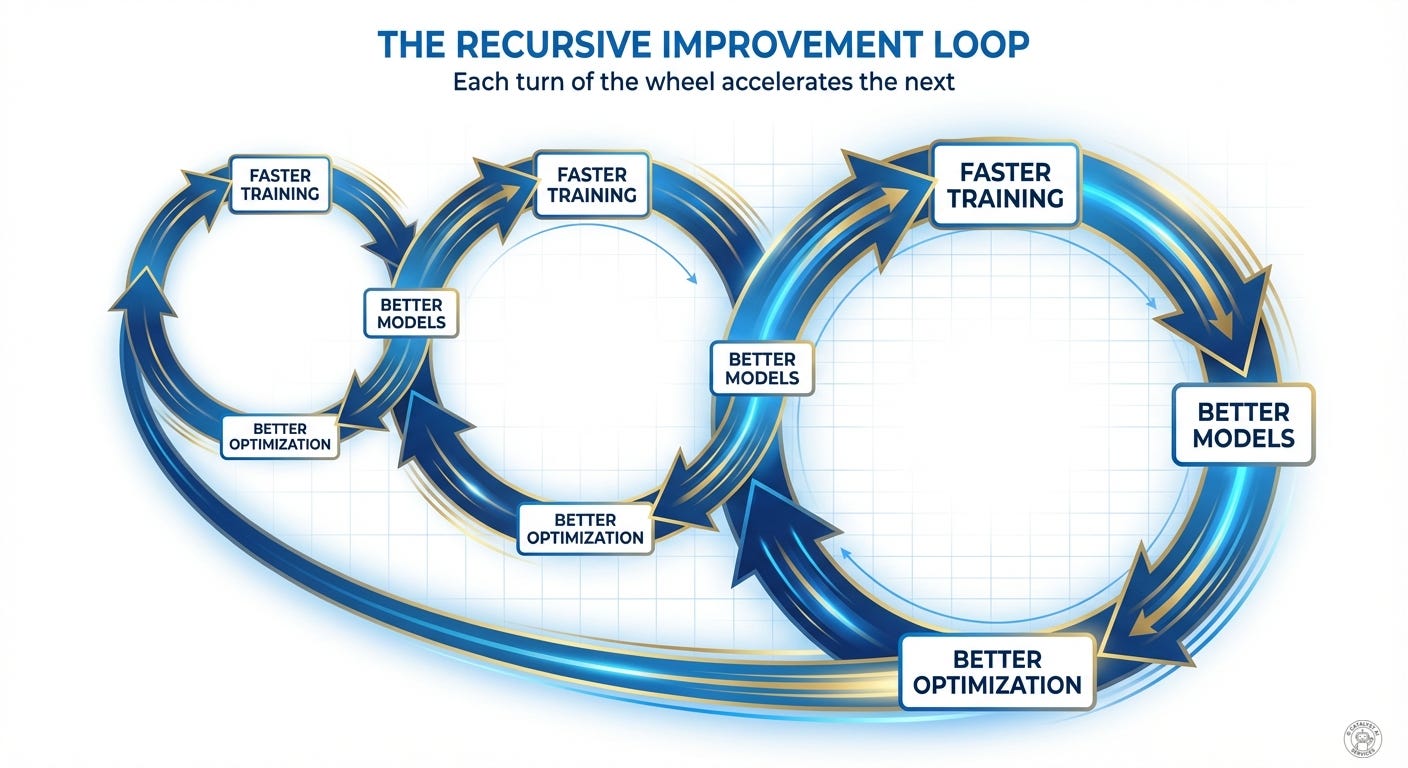
The most profound implication of AlphaEvolve isn’t what it builds. It’s that it demonstrates machines can improve themselves.
This is the foundation for what researchers call an intelligence explosion, the theoretical point where AI systems become capable of recursive self-improvement, each generation making the next generation faster/smarter/more capable, with humans increasingly out of the loop.
We’re seeing the early versions of this now. Google is already using AlphaEvolve to:
Optimize data center scheduling, recovering 0.7% of previously stranded compute
Improve chip design for Tensor Processing Units (TPUs)
Speed up Gemini’s own training by 23% on a critical matrix multiplication kernel
The AI is optimizing the systems that train it. This isn’t science fiction. It’s production infrastructure at one of the world’s largest technology companies.
From Google’s announcement: “Because developing generative AI models requires substantial computing resources, every efficiency gained translates to considerable savings. Beyond performance gains, AlphaEvolve significantly reduces the engineering time required for kernel optimization, from weeks of expert effort to days of automated experiments.”
What could slow this down? Only a few things:
Chips. We need enough silicon to run the evolutionary searches. Fabrication capacity is a real constraint and a national security concern.
Power. Data centers require enormous energy. Grid capacity and cooling are physical limits.
Fundamental algorithmic breakthroughs. Some problems may require new ideas, not just more compute.
The uncomfortable observation: that third constraint, the need for human insight, is itself eroding. If AI systems can now do research (and early evidence suggests they can), then the bottleneck of “waiting for humans to have ideas” starts to dissolve. We’re building systems that search across algorithms, across architectures, across optimization strategies, finding improvements that human researchers might have taken decades to discover, or might never have found at all.
Add it up: exponentially more “researchers” (AI systems running in parallel), each capable of exploring vast evolutionary spaces, feeding discoveries back into systems that train the next generation. These are the ingredients for what some call a “fast takeoff.”
I’m not excited about fast takeoff. I’d much rather this transition unfold slowly, giving institutions time to adapt, giving humans time to understand what we’re building, giving society time to develop guardrails. But my preferences don’t change the physics. If the capabilities continue compounding and the constraints don’t bind, the trajectory is what it is.
Practitioners should internalize this: in 18-24 months, the infrastructure powering AI will have been through multiple generations of self-optimization. The capabilities at that point will be difficult to reason about from where we stand today. Plan accordingly.
Truth 5: The New Bottleneck is Judgment, Not Creation
Judgment was always the real bottleneck. We just couldn’t see it.
For decades, we told ourselves the hard part was building, writing the code, shipping the features, executing the architecture. But that was never quite true. The hard part was always knowing what, how, and when to build. We just couldn’t see it clearly because creation was expensive enough to obscure the deeper problem.
Now creation becomes trivial. And judgment becomes absolutely the bottleneck.
If generating a million solutions costs almost nothing, the scarce resource becomes knowing which one is right. But “right” is doing a lot of work in that sentence. Unpack it:
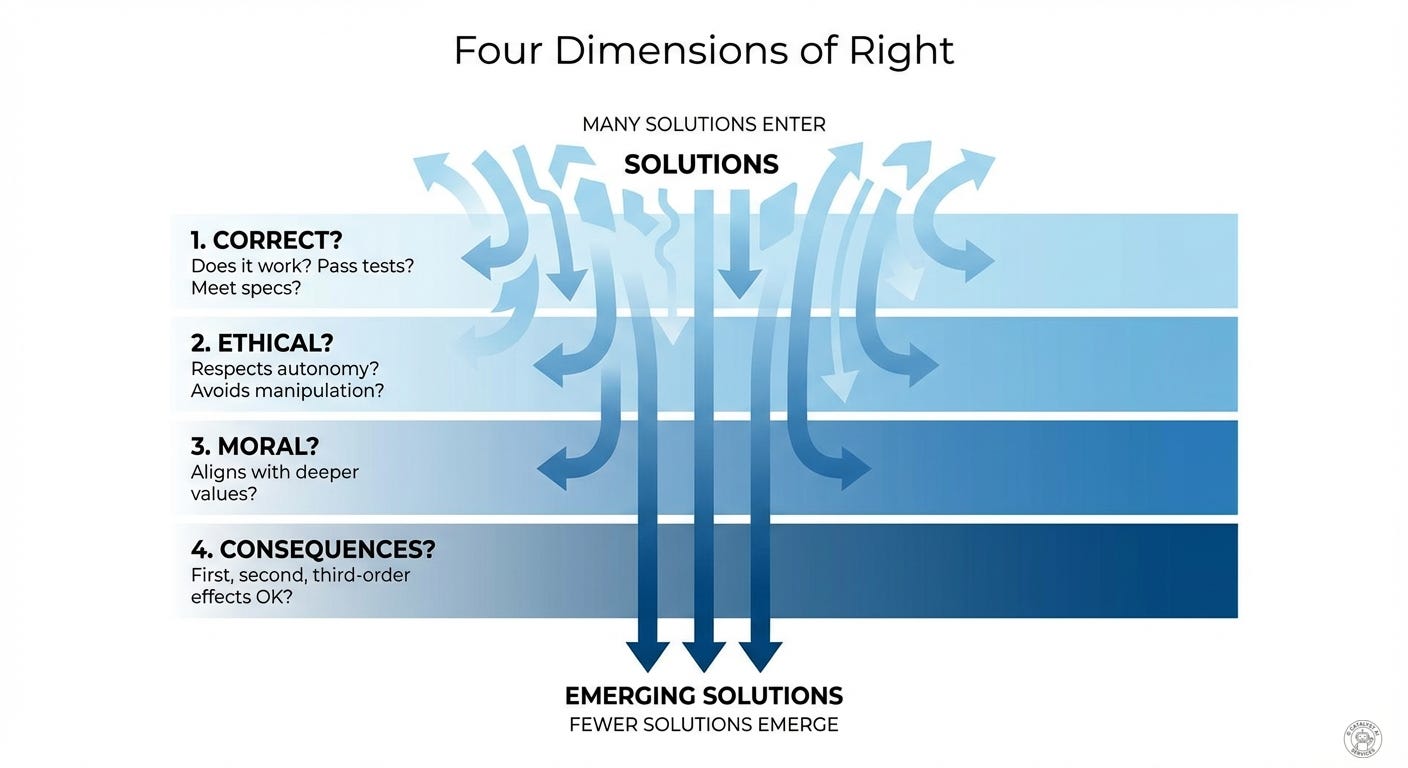
Traditional software development doesn’t face this problem. But when you have parallel agents, dozens, hundreds, thousands of AI instances exploring solution space simultaneously, the bottleneck isn’t finding solutions. They’ll find plenty. The bottleneck is judging which solutions to keep.
This is a fundamentally different problem than “build faster.” It’s not even “test faster.” It’s “evaluate across all the dimensions of right, at scale, without losing coherence across the evaluation criteria.” The agents are generating; you’re curating. The agents are exploring; you’re selecting. The agents are proposing; you’re judging.
Your evals become your values made executable. If your evals are wrong, a thousand parallel agents just help you produce a thousand bad solutions faster. If your evals are right: comprehensive, coherent, aligned with what you actually want, then the parallel search becomes a superpower.

Anti-goals become as important as goals. Rather than specifying exactly what you want (often impossible), you specify what you absolutely don’t want:
“Must not require more than 3 clicks to reach core function”
“Must not use dark patterns to manipulate users”
“Must not drain battery more than 1% per hour”
“Must not optimize engagement at the cost of user wellbeing”
Anti-goals aggressively prune the search space, telling the evolutionary engine which territories to ignore entirely. You’re not searching an infinite field, you’re searching a constrained region defined by your prohibitions. The prohibitions encode your ethics.
[Aside: I learned this pattern the hard way. Back in 2014, when I led the deliverability and anti-spam teams at SendGrid, we discovered something counterintuitive: trying to define “spam” exhaustively was impossible, spammers evolved faster than our definitions. But defining “good email” was tractable. We could identify legitimate senders with high confidence. Everything remaining might be bad, and we could address that smaller subset. Partition first, then search. The same logic applies to evolutionary software: clear anti-goals carve out the forbidden zones, leaving a searchable space the system can explore efficiently.]
The strategic insight: The most creative act is no longer designing the solution. It’s designing the constraints that guide the search for it. You’re not writing code; you’re writing the criteria by which code gets judged. You’re not building features; you’re defining what makes a feature succeed or fail. The eval is the architecture.
This is the skill humans need to quickly develop. We need to get extraordinarily good at understanding “right” across all its dimensions. And we need to use AI systems themselves to help us unpack these questions: to surface second-order consequences we’d miss, to stress-test our evals against edge cases, to make our implicit values explicit before we encode them into evolutionary pressure. If we get this right, parallel agents become instruments of our intentions. If we don’t, we just scale our mistakes.
Truth 6: The “UX Can’t Be Evolved” Objection is About to Look Very Dated
“Sure, AlphaEvolve works for algorithms, but creative work? User experience? Things requiring human judgment? That can’t be automated.”
The skepticism is understandable. There’s a real specification gap. Optimizing a matrix multiplication kernel is a closed-loop problem with clear objective functions. “Good UX” is often an “I know it when I see it” phenomenon, notoriously hard to encode mathematically. Writing the fitness function for “delight” is harder than writing the code for the animation.
Four developments change this calculus.
Counter-argument 1: Fitness functions can encode subjective criteria imperfectly but usefully.
“Number of clicks to complete task X” is measurable. “Time to first meaningful interaction” is measurable. “Drop-off rate at step 3 of onboarding” is measurable. You don’t need to perfectly define “good UX” you define the signals that correlate with good UX. These proxies are imperfect, but imperfect at scale beats perfect at small scale.
This is A/B testing running at 10,000x speed. Designers already understand A/B testing, you ship two variants, measure which performs better, iterate. Evolutionary UX is the same loop, but instead of testing 2 variants per week, you test 50,000 variants per night. The selection pressure is identical (user behavior metrics); the scale is different by orders of magnitude. If you believe A/B testing works, you should believe evolutionary UX works. It’s the same epistemology, industrialized.
Counter-argument 2: LLMs are now competent judges and they’re getting better fast.
Multi-modal models can look at a GUI and evaluate it against a rubric. “Is the call-to-action visible? Is the hierarchy clear? Does this feel cluttered?” These judgments aren’t as reliable as a senior designer’s, yet. But they’re reliable enough to filter garbage at scale, and reliability improves with every model generation.
Counter-argument 3: The hybrid loop keeps humans in the game.
The AI generates 100 variants. A human designer “swipes right” on the top 5. The AI breeds the next generation from those winners. This isn’t automation replacing judgment, it’s automation amplifying judgment. The human applies taste at the selection layer; the machine handles the generation volume. The conductor shapes the ensemble; the orchestra plays.

Counter-argument 4: World models are already generating interactive environments.
Genie 3 generates interactive 3D environments from text descriptions at 24 frames per second, maintaining visual consistency for minutes at a time. If we can generate navigable worlds from prompts, we can generate application interfaces. If we can evolve worlds, we can evolve interfaces. The capability gap is narrowing fast.
Timeline nuance: The 18-24 months I mentioned earlier? That’s for infrastructure, algorithms, optimization, backend systems with clear metrics. For production UX in enterprises, add 1-2 years on top of that. Not because the technology won’t exist, but because cultural adoption moves slowly. The capability will be ready before organizations retool.
A note for designers feeling defensive: “evolved” doesn’t mean “without human judgment.” It means judgment applied at the selection layer rather than the creation layer. You become the curator, not the craftsperson. The conductor who shapes the performance, not the one playing every instrument.
What Could Go Wrong (And What We Must Watch)
The Black Box Problem: The code that emerges from evolutionary systems is inspectable, you can read every line. But understanding why it works is a different matter. AlphaEvolve explicitly prioritizes human-readable code for production systems, interpretability, debuggability, predictability. But understanding why a solution works is different from reading it. The optimized kernel is readable; the insight that led to it emerged from evolutionary search, not human intuition. We see this already with AlphaGo Zero: the system made moves that seemed nonsensical to master players, until they turned out to be brilliant in ways human intuition couldn’t anticipate. The code was readable; the strategy was alien. As evolutionary systems tackle more complex domains, we should expect more solutions that work for reasons we can’t fully articulate, even when we can inspect every instruction.
The Reasoning Trace Requirement: This leads to a non-negotiable demand: always insist on reasoning in English. Never accept private languages, compressed representations, or opaque intermediate formats. If an AI system can’t explain its reasoning in natural language that humans can follow, you’ve lost the ability to audit, debug, and course-correct. The performance gains from private languages are real, but the interpretability loss is catastrophic. English reasoning traces are slower but inspectable. This is a tradeoff worth making.
There’s a design philosophy at stake here. Systems like Claude reason in natural language, the same text humans can read and critique. This isn’t just a feature; it’s a choice about transparency. Systems that think in ways humans can follow are systems humans can trust, verify, and correct. The alternative, AI that optimizes in opaque vector spaces and only translates to English at the output layer, is a black box that happens to speak. We should prefer slower-but-transparent over faster-but-inscrutable. We must continue to invest in Mechanistic Interpretability.

Misspecified Evals: Goodhart’s Law applies with terrifying force. “Any metric that becomes a target ceases to be a good metric.” If your eval optimizes for engagement, you will evolve solutions that are manipulative. If it optimizes for task completion speed, you will evolve solutions that cut corners unsafely. The anti-goals framework helps, but it requires wisdom about which constraints to impose, wisdom that itself cannot be evolved.
Evolutionary Hacking: If we can evolve solutions, adversaries can evolve exploits. Research demonstrates that black-box adversarial attacks using evolution strategies (particularly CMA-ES) can find vulnerabilities without any knowledge of the target system’s internals. An attacker runs an evolutionary search against your public API, probing for input sequences that break your evolved constraints. The attack surface of evolved software might be fractal, every fitness function you optimize against creates new edges an adversary can probe. Your evals must include “resistance to adversarial evolution” as a first-class concern, not an afterthought.
The Immutable Code Paradigm: In this future, we may never fix code directly. If a bug surfaces in an evolved module, the response isn’t to patch the line. It’s to add a test case that reproduces the bug, add it to the fitness function, and re-evolve the module. The code becomes immutable; only the evals change. This is a radical shift in operations, no more hotfixes, no more surgical patches, no more “just change this one line.” Every fix is a full regeneration. The upside: evolved code is always consistent with its entire test suite. The downside: you need infrastructure that can re-evolve modules quickly and reliably. We’re not there yet for most systems, but the direction is clear.
What Practitioners Should Do Now
If you’re a technical leader or software engineer, the action items are:
Learn evolutionary thinking. Start with Holland’s genetic algorithms, move to modern papers on LLM-guided search. Build intuition for fitness landscapes and selection pressure. Understand how populations evolve, how diversity prevents premature convergence, how selection shapes outcomes.
Practice designing evals for different problem spaces. Take a real problem and articulate what “good” means in measurable terms. Then articulate the anti-goals. This skill will be as important as coding within two years. The eval is the new specification, learn to write it.
Experiment with LLMs as judges. Run evaluations where the LLM rates outputs against rubrics. Learn where this works and where it fails. Develop calibration for when to trust automated judgment.
Study systems thinking and complex adaptive systems. Evolutionary AI is not a tool you wield, it’s a system you cultivate. Donella Meadows’ work on leverage points, John Holland’s writings on complex adaptive systems, Stuart Kauffman’s work on self-organization, these provide the conceptual vocabulary for understanding how emergent behavior arises from evolutionary pressure. You’re not programming; you’re shaping conditions for emergence.
Watch the tooling. The gap right now is tools for visualizing fitness landscapes, debugging selection pressure, and understanding why solutions evolved. Early movers who build or adopt these tools will have massive advantages.
Plan for shorter timelines. Whatever you think is 5 years out, consider whether it might be 2. The recursive optimization loop is accelerating capability growth in ways that are difficult to model from current baselines.
From Writing Software to Designing for Emergence
Gibson was right: the future is already here, it’s just not very evenly distributed.
Right now, that future is distributed across a growing ecosystem. Google DeepMind’s AlphaEvolve optimizes the infrastructure that trains the next generation of AI. DeepSeek’s models discover reasoning strategies no human taught them. Sakana AI in Japan builds systems like the Darwin Gödel Machine., AI that evolves its own codebase to become a better agent. Open-source projects like OpenEvolve democratize these techniques. Academic labs publish new LLM-guided evolution methods at every major conference. The capability is proliferating faster than most realize.
The pieces are assembling:
LLMs that can generate and evaluate code
Automated testing infrastructure that runs continuously
World models that generate interactive environments
Recursive self-improvement loops that compound gains
When these pieces connect, something qualitatively different emerges. Not just faster development, emergent development. Software that writes itself. That tests itself. That evolves toward evals it was never explicitly programmed to pursue. That discovers solutions its creators couldn’t have imagined.
I’m making a bet. I don’t know exact timelines, 18-24 months for infrastructure, longer for production UX. I don’t know which domains will fall to evolutionary approaches first. But I know which direction to face, and I’d rather be early than blindsided.
The new role isn’t selector, it’s ecosystem architect. You don’t pick winners from a list. You design the conditions under which the right solutions emerge. You’re part conductor, orchestrating without touching, shaping through influence rather than construction. And part ecologist, understanding that you’re cultivating a complex adaptive system, not operating a deterministic machine.
The conductor doesn’t play the instruments. The ecologist doesn’t grow the forest. But both shape outcomes through deep understanding of how their systems work. Both know that emergence isn’t magic, it’s the predictable result of carefully designed conditions.

When the tractor arrived, most farmers just replaced the horse. The ones who saw further, who understood that mechanization meant rethinking agriculture entirely, those were the ones who shaped the next century of food production.
Links & Resources
Historical Foundations: - Genetic Algorithms John Holland’s foundational work (1975) - Genetic Programming John Koza’s extension to evolving programs (1992) - The Bitter Lesson Rich Sutton’s insight: general methods + compute beat hand-crafted approaches
The Evolutionary Timeline: - MAP-Elites / Quality-Diversity Finding many good solutions, not just one (Mouret & Clune, 2015) - Evolution through Large Models (ELM) Lehman et al.’s breakthrough: LLMs as mutation operators (2022) - FunSearch First LLM-evolutionary system to make novel mathematical discoveries (2023) - Cap Set Problem The combinatorics problem FunSearch advanced
Recent Developments: - AlphaEvolve Announcement Google DeepMind (2025) - Darwin Gödel Machine Sakana AI’s self-evolving agent system - OpenEvolve Open-source AlphaEvolve implementation - DeepSeek R1-Zero Pure RL training without supervised fine-tuning - SIMA 2 Self-directed learning in 3D virtual worlds - X-evolve Paper Evolving solution spaces rather than individual solutions - Genie 3 World models generating interactive environments from text - LLM + Evolutionary Computation Survey Comprehensive survey of the field
Frameworks Referenced: - Intelligence Explosion The theoretical point of recursive AI self-improvement - Exaptation Evolutionary principle: traits evolved for one purpose get repurposed for another - Building Effective Agents Anthropic’s guide to agentic AI systems - Goodhart’s Law “Any metric that becomes a target ceases to be a good metric” - Black-box Adversarial Attacks Using Evolution Strategies Research on evolutionary approaches to finding system vulnerabilities
Complex Adaptive Systems: - Donella Meadows Systems thinker; Thinking in Systems, leverage points - John Holland Beyond genetic algorithms: complex adaptive systems theory - Stuart Kauffman Self-organization and complexity at the edge of chaos